Thesis Defense Presentation Template: A Practical Guide for Graduate Students
Few academic hurdles carry as much weight as the thesis defense. After months—or years—of research, writing, and revision, standing before a committee to present and defend your work is a defining moment. The strength of your research matters most, but the clarity and professionalism of your slides can significantly influence how your findings are received. A well-designed presentation helps your committee follow your argument without struggling with cluttered slides, inconsistent formatting, or unclear visuals. That is where a purpose-built resource like the Thesis Defense Presentation Template becomes genuinely useful.
What Is the Thesis Defense Presentation Template?
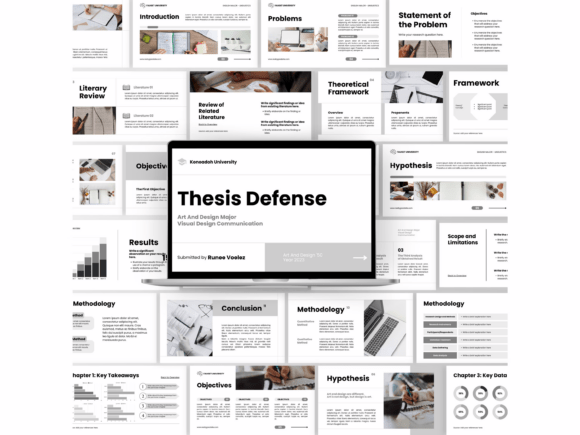
At its core, the Thesis Defense Presentation Template is a complete slide deck designed specifically for academic defenses. It provides forty-five professionally designed slides that work with both Canva and PowerPoint. The set includes data visualization tools—charts, graphs, and infographics—to help you display research findings clearly. The slides are crafted to give a polished, cohesive look without requiring hours of design work. The resource is produced by academic professionals with experience guiding successful defenses, which gives its structure a practical, field-tested foundation.
This is not a generic presentation kit repurposed for students. Every slide is built around the needs of a thesis defense presentation: introducing the research problem, reviewing literature, presenting methodology, sharing results, discussing implications, and concluding with a strong takeaway. The content structure mirrors standard defense formats, which saves you from reinventing the layout and lets you focus on your unique research narrative.
Professional Design Without the Learning Curve
One of the biggest stressors for graduate students is creating slides that look credible. Many researchers are experts in their field but have little training in visual design. This template removes that pressure. The color schemes, typography, and slide layouts are consistent and modern. You can drop your content into the provided slides and immediately have a presentation that looks intentional and polished. The template avoids flashy, distracting elements. It stays focused on readability and professionalism, which is exactly what a defense committee expects.
Data Visualization That Clarifies Your Research
Research presentations often rely on complex data. Showing raw numbers or dense tables rarely helps an audience grasp your findings quickly. The template includes pre-built chart and graph layouts designed for academic contexts. You can customize these visuals with your own data, and the result is a clean infographic that communicates your results at a glance. This is particularly valuable for methodology sections where you need to explain experimental design or statistical analyses. The templates for comparative charts, process flows, and data maps give you flexible options without requiring advanced design skills.
Time Efficiency and Workflow Integration
Graduate students operate on tight schedules. The template's instant download means you can begin working within minutes of purchase. Because it works with both Canva and PowerPoint, you can use whichever platform fits your existing workflow. Canva offers easy browser-based editing and collaboration, while PowerPoint gives you the offline stability many users prefer. The forty-five slide count covers a full defense presentation, so you are unlikely to need external slides or supplementary decks. This single resource replaces the need to piece together multiple templates or start from scratch.
Real-World Usability and Flexibility
Practical testing shows the template handles a range of academic disciplines well. While it leans toward a generic academic aesthetic, the modular slide structure allows for customization. You can rearrange sections, duplicate useful slides, and remove ones that do not apply. The data visualization tools are particularly effective for STEM fields, but social science and humanities researchers will find the infographic timelines, comparison slides, and text-heavy layout options equally useful.
Sharing your presentation digitally is straightforward. The template is designed for digital distribution, whether you are presenting in person via projector or remotely over Zoom, Google Meet, or Teams. The slide dimensions and font sizes are optimized for screen viewing, and readability holds up well on both large displays and individual monitors. For users who prefer physical handouts, the slides print cleanly in grayscale and color.
PhD and Masters Candidates Preparing for Defense
This is the primary audience. If you are within three to six months of your defense and still building your presentation, this template can save a significant amount of planning time. The slide structure helps you organize your narrative logically, which is especially helpful if you are struggling to condense years of work into a twenty- to forty-minute presentation.
Non-Native English Speakers and International Students
Presenting in a second language adds another layer of difficulty. Having slides that are visually clear and well-structured reduces the cognitive load of managing both language and content. The consistent design means your audience can follow your argument visually, even if your spoken delivery has minor hesitations. This template gives international students one less thing to worry about.
Students With Limited Design Experience
Not everyone has an eye for layout or color pairing. If you normally rely on university slide templates that look outdated or generic, this resource offers a significant upgrade. You do not need to learn design principles to get a professional result. The template does the heavy lifting, and you simply add your content.
Educators and Advisors Supporting Student Defenses
Faculty members who supervise graduate students may also find value in this resource. You can recommend the template to students who struggle with presentation quality, knowing it is designed by professionals with academic experience. It serves as both a time-saving tool and a teaching aid for students learning how to structure a defense talk.
Potential Limitations to Consider
No template is a perfect fit for every situation. The Thesis Defense Presentation Template is broadly useful, but it may require customization to match specific institutional guidelines. Some universities have strict formatting requirements for defense presentations, including specific fonts, color schemes, or branding. You should verify whether your department has such rules before committing to a template.
The slide count of forty-five is generous, but some defenses require a longer or shorter presentation. If your committee expects a sixty-minute talk with extensive appendix materials, you may need to supplement the deck. Conversely, if your defense is brief, you might find yourself cutting slides down. Neither scenario is a dealbreaker, but it is worth planning for.
Additionally, while the template's design is polished, it is not infinitely flexible. Users with very specific visualization needs—such as custom anatomical diagrams, field-specific wiring schematics, or highly unusual data formats—may need to create those elements outside the template and import them. The included graphs and charts cover common academic formats, but they are not exhaustive for every discipline.
Long-Term Value and Reusability
One practical advantage worth noting is that this template does not disappear after your defense. The slide deck can serve as a foundation for conference presentations, job talks, and academic lectures. The layouts are general enough that you can repurpose them for future professional work. For researchers who continue presenting throughout their careers, this is a resource with longevity.
The instant download and digital sharing capabilities also mean you can store the template and reuse it indefinitely. If you change institutions or shift research areas, you still have a presentation framework ready to go. This extends the value beyond a single use case.
Final Considerations for Choosing the Right Tool
Deciding whether the Thesis Defense Presentation Template fits your needs comes down to your current situation. If you have a clear research narrative but lack the design skills or time to build slides from scratch, this is a strong investment. It removes the most common friction points in defense preparation: inconsistent visuals, unclear data presentation, and last-minute formatting stress. The resource is built by people who understand the defense process, which gives it credibility beyond what a generic template offers.
If you already have a strong design background or access to a dedicated university presentation team, you may not need an external template. But for the majority of graduate students juggling research, writing, and teaching responsibilities, this resource fills a genuine gap. It lets you walk into your defense knowing your slides support your argument instead of undermining it. That confidence alone can make a measurable difference in how you present and how your committee perceives your work.