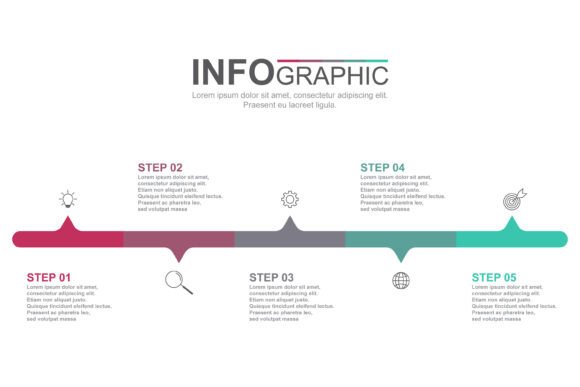
Modern Infographic with Five Steps: A Strategic Approach to Visual Communication
In a world where attention is scarce and complexity is abundant, presenting information clearly can make the difference between an idea that sticks and one that gets lost. The Modern Infographic with Five Steps is more than a design template—it is a structured framework for translating abstract concepts into visual narratives that audiences can grasp quickly and act upon. Whether you are an entrepreneur outlining a growth plan, a marketer explaining a customer journey, or an educator breaking down a process, this infographic style offers a proven way to organize thinking and drive understanding.
What sets this particular format apart is its balance between sophistication and simplicity. With vibrant colors, scalable icons, and multiple file formats (AI, EPS, JPEG), it is built to adapt across presentations, reports, and marketing materials. But the true value lies not in the polish but in the strategic discipline it encourages: distilling a process into five distinct, logical steps forces clarity on the creator and provides a clear path for the viewer. Used thoughtfully, a five-step infographic can become a cornerstone of your communication strategy, improving decision-making, alignment, and long-term results.
Why Visual Frameworks Matter for Decision-Making and Goal Achievement
Humans are wired to process visual information rapidly. A well-designed infographic bypasses the need for heavy reading and instead presents a map that the brain can traverse at a glance. For professionals and business owners who need to make decisions—often under time pressure—having a visual reference that outlines steps or stages reduces cognitive load. Instead of holding multiple variables in memory, a clear infographic acts as an external thinking tool.
When you adopt a Modern Infographic with Five Steps, you are essentially committing to a structure that forces prioritization. You cannot list ten things; you must choose five. This limitation is actually a strength. It compels you to identify what is genuinely essential, which is a prerequisite for effective planning and goal-setting. Whether you are designing a product roadmap, a sales funnel, or a learning module, the five-step frame provides a scaffold that keeps both you and your audience focused on the key milestones rather than getting lost in details.
From a strategic standpoint, this format also supports better retention. Research shows that people remember visual information far longer than text. When you embed your core message into a five-step visual, you improve the likelihood that your stakeholders—team members, clients, investors—will recall the sequence and apply it later. This is particularly valuable in marketing and branding, where consistent messaging across touchpoints builds trust and recognition.
Strategic Uses of the Modern Infographic with Five Steps
The versatility of this infographic style means it can serve multiple strategic functions depending on your context. Below are several high-impact use cases that align with common business and educational goals.
Planning and Process Mapping
Use the five-step layout to map out any linear or cyclical process. For example, a project manager might illustrate the stages of a product launch: research, development, testing, launch, and iteration. Each step becomes a visual milestone that the team can reference during meetings and check-ins. This not only clarifies roles but also reveals gaps in logic—if you cannot reduce your process to five steps, you may need to reconsider its coherence. Additionally, having a polished infographic in EPS or AI format allows you to embed it in slide decks or reports without worrying about resolution.
Positioning and Brand Communication
Marketers often need to explain a value proposition or customer journey in a compelling way. A Modern Infographic with Five Steps can visually guide a prospect from problem awareness to solution adoption. For instance, a SaaS company might illustrate the five phases of becoming a customer: discover, trial, onboard, integrate, and succeed. This not only educates but also pre-frames the experience, reducing friction and setting expectations. By using consistent brand colors and icons, the infographic reinforces brand identity while delivering practical information.
Educational Content and Learning Aids
Educators and trainers can break down complex topics into digestible steps. Whether explaining the scientific method, a business model canvas, or a compliance procedure, the five-step format helps learners build mental models. Because the design is modern and visually appealing, it holds attention better than bullet lists or dense paragraphs. You can distribute the JPEG version for quick reference or use the AI file to customize steps for different courses or workshops.
Creativity and Brainstorming Anchors
Creative professionals often struggle with organizing divergent ideas. A five-step infographic can serve as a constraint for brainstorming sessions. Ask participants to fill in each step with a key action or insight. This turns a chaotic whiteboard session into a structured output that can be refined later. The format encourages convergent thinking after the divergent phase, helping teams move from ideas to action plans.
When and How to Use It Effectively
Timing and context matter. A five-step infographic works best when you want to convey a sequence or framework that the audience needs to understand in order to act. It is less suited for presenting large volumes of data or highly nuanced arguments that require narrative flow. Use it when you need clarity over depth, and when you want your audience to remember the structure rather than the details.
Approach the creation process with intention. Start by defining the goal of the infographic: Is it to explain, to persuade, or to guide? Then list all possible steps and ruthlessly edit down to five. Look for steps that are logically sequential and mutually exclusive. Avoid labeling a step too broadly; each should be a specific action or stage. For example, instead of “Marketing” as a step, use “Generate Leads” or “Build Awareness.” The more precise the language, the more actionable the infographic becomes.
When designing, leverage the included file formats. Use the AI version if you need to tweak colors, swap icons, or adjust text to match your brand guidelines. The EPS file offers similar flexibility for vector editing. Keep the JPEG as a fallback for quick sharing or embedding in emails. Be mindful of contrast and readability—vibrant colors are engaging but should not compromise text legibility. Test the infographic on a small audience before rolling it out broadly to ensure the steps are intuitive.
Planning Tips and Strategic Considerations
Before relying on a five-step infographic for a critical communication, consider the following:
- Audience familiarity: If your audience is new to the subject, ensure the steps build on each other logically. Avoid jargon or overly technical terms.
- Medium: An infographic that works on a slide may not work in a printed report. The JPEG version is screen-friendly; the AI/EPS formats allow you to rescale for print without pixelation.
- Consistency: If you create multiple infographics (e.g., for different departments or products), keep a consistent visual language. This builds a recognizable system that reduces cognitive load across your organization.
- Call to action: The final step should often imply a next action. Whether it is “Measure Results” or “Get Started,” make sure your infographic leads the viewer somewhere.
Another strategic layer is to use the infographic as a diagnostic tool. For instance, if you are planning a new business process, try mapping it in five steps before writing a full document. If you find the steps overlapping or missing, that signals a flaw in your logic early on. This saves time and prevents costly misalignment later.
Risks of Using a Five-Step Infographic Without Clear Goals
Even a well-designed infographic can fail if it is created without a clear purpose. One common pitfall is trying to force a five-step structure onto a process that naturally has more or fewer stages. This can lead to steps that feel arbitrary or confusing, undermining the very clarity you are trying to achieve. For example, a five-step customer journey might omit a critical touchpoint like “post-purchase support,” leading to incomplete communication and frustrated stakeholders.
Another risk is aesthetic overload. While the Modern Infographic with Five Steps comes with vibrant colors and icons, using them without restraint can distract from the message. Too many visual elements can make the infographic feel busy and reduce its effectiveness as a communication tool. Always prioritize function over decoration. If a chart or icon does not add understanding, consider removing it.
Finally, there is the risk of over-reliance. An infographic is a summary, not a substitute for detail. If your audience needs deeper context, supplement the visual with a written explanation or a verbal walkthrough. Using the infographic as a standalone document when more is required can create misunderstandings or false confidence. Treat it as a catalyst for conversation, not a conclusion.
Long-Term Value and Integration into Your Workflow
When used consistently, the Modern Infographic with Five Steps becomes more than a one-off asset—it becomes a reusable framework that scales across projects. By keeping the AI and EPS source files organized, you can quickly adapt a proven layout to new topics. Over time, you build a library of visual templates that reflect your brand’s strategic thinking. This not only saves design time but also reinforces your reputation for clarity and professionalism.
Furthermore, aligning your infographic style with your overall communication strategy creates a unified experience for your audience. Whether they see your infographic in a blog post, a sales deck, or an internal training manual, the familiar layout signals reliability. For entrepreneurs and small business owners, this consistency is a subtle yet powerful branding tool that builds trust without additional effort.
To maximize long-term value, treat each infographic as a living document. As your business evolves, revisit the steps. Update the language, swap out icons, or reorder stages based on new insights. The editable file formats make such iteration straightforward, ensuring your visual communication stays relevant and accurate.
Using the Infographic Intentionally Rather Than Randomly
The difference between an infographic that drives results and one that gathers dust often comes down to intentionality. Before you open the design file, ask yourself: What specific decision should the viewer make after seeing this? What is the one thing I want them to remember? Answering these questions shapes every element—from the step labels to the color palette.
Resist the temptation to use the infographic simply because it looks attractive. Instead, integrate it into a broader communication sequence. For example, if you are launching a new product, you might first send a teaser email, then share the infographic to explain the process, followed by a detailed case study. In this sequence, the infographic serves as the middle layer—more visual than the initial announcement but more concise than the deep dive. This layered approach respects the audience’s time and attention span while gradually building understanding.
Finally, gather feedback. Share the infographic with a few trusted colleagues or customers and ask them to explain the steps back to you. If they can do so accurately, your design has succeeded. If not, refine until the message is unmistakable. This iterative cycle ensures that your Modern Infographic with Five Steps is not just a download but a strategic tool that genuinely enhances communication and decision-making. When used with purpose, it becomes one of the most efficient ways to turn complex ideas into shared understanding—and shared understanding is the foundation of every successful collaboration.