Business 3D Icon Design and Its Role in Modern Digital Storytelling
Visual communication in the business world has undergone a quiet transformation. Flat icons, once the standard for clean interfaces, now share the stage with richer, more dimensional visuals. Among these, Business 3D Icon Design has emerged as a practical tool for conveying ideas with clarity and personality. This shift is not merely aesthetic; it reflects a deeper need for assets that feel tactile, memorable, and adaptable across platforms. A well-crafted Business 3D Icon Design pack does more than decorate a slide or website — it anchors a brand's visual language in a way that static silhouettes cannot.
Consider how the human eye responds to depth, shadow, and light. These cues signal realism and presence, making Business 3D Icon Design particularly effective for capturing attention in crowded digital environments. A chubby 3D style, with its soft curves and vibrant color palette, brings a sense of approachability and warmth to corporate visuals. This is especially valuable for startups and small teams that want to project professionalism without appearing cold or impersonal. The tactile quality of a rounded 3D icon invites interaction, whether it appears on a landing page, inside a mobile app, or within a pitch deck.
Why Dimensionality Matters in Business Visuals
The shift from two-dimensional to three-dimensional iconography is not arbitrary. Flat design solved early screen resolution challenges and load speed concerns, but as display technology improved and user expectations evolved, the need for more expressive visuals grew. Business 3D Icon Design answers that need by offering a middle ground between realism and abstraction. Icons retain their symbolic clarity while gaining a sense of volume that makes them feel contemporary and engaging.
Research in visual cognition suggests that people process images with depth cues faster and retain them longer. When a business icon depicts a lightbulb, a handshake, or a growth chart, adding three-dimensional rendering — highlights, shadows, and surface textures — helps the brain interpret the object more naturally. This is particularly relevant for abstract concepts like strategy, innovation, or leadership, where a literal flat shape may feel incomplete. A chubby 3D icon of a hologram or a VR headset, for example, immediately signals future-forward thinking without requiring additional text. The Business 3D Icon Design pack referenced here includes such objects — avatar, crypto coin, portal — which speak directly to the vocabulary of the metaverse and digital transformation.
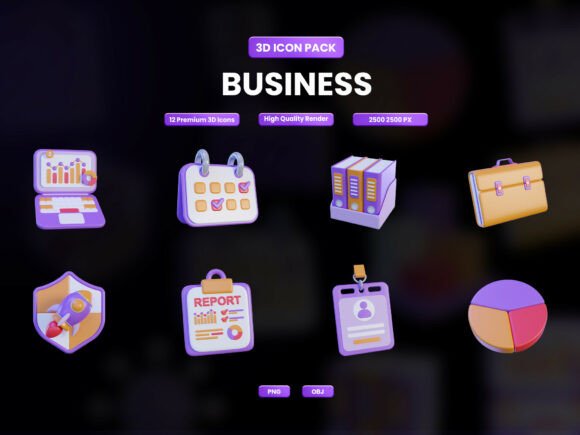
Another practical advantage is versatility. A high-resolution 3D icon at 2500x2500 pixels with a transparent background can be dropped into a presentation, a social media graphic, a website header, or a printed brochure without rework. The chubby style, with its smooth gradients and consistent lighting, ensures that icons from the same set look cohesive even when resized or placed on different background colors. This consistency saves time for designers and marketers who would otherwise need to create custom illustrations for each use case. A single Business 3D Icon Design pack thus becomes a scalable component of a brand's visual system.
Core Characteristics of a Quality 3D Icon Set
Not all 3D icons perform equally in professional settings. Several characteristics separate a usable icon pack from one that feels gimmicky or inconsistent. The first is resolution and file transparency. PNG files at 2500x2500 pixels offer enough detail for retina displays, large format printing, and video overlays. A transparent background is non-negotiable for flexible placement across different media without awkward white boxes or clipping issues. The chubby style, characterized by rounded edges, soft specular highlights, and saturated colors, ensures that icons remain legible even when scaled down to thumbnail sizes.
The second characteristic is thematic coherence. A Business 3D Icon Design set should cover a logical range of business concepts — from individual roles like team members and leaders to abstract ideas like growth, communication, and digital assets. When each icon shares the same lighting angle, shadow depth, and color temperature, the set feels unified. This is crucial for branding materials where visual consistency directly impacts perceived professionalism. The inclusion of metaverse-related objects such as VR headsets, portals, and holograms indicates a forward-looking design approach, acknowledging that modern business increasingly intersects with virtual and augmented environments. For educators and researchers presenting on digital transformation, these icons provide concrete visual anchors that audiences can immediately grasp.
Third, the rendering quality matters. Smooth shading, anti-aliased edges, and realistic reflections contribute to the polished look that distinguishes professional design assets from amateur work. A well-rendered chubby 3D icon of a crypto coin, for instance, should clearly convey material and lighting — a metallic sheen, a subtle rim light, and a soft drop shadow that grounds the object. These details, while subtle, build trust with the viewer. For business owners and startup founders who may not have in-house design teams, investing in a high-quality Business 3D Icon Design pack is a cost-effective way to elevate their brand's visual presence without custom illustration costs.
Practical Applications Across Workflows and Industries
The real value of any design asset lies in its day-to-day usefulness. Business 3D Icon Design finds application in a variety of scenarios that span industries and job functions. In startup entrepreneurship projects, where speed and impact are critical, a consistent icon set helps founders communicate complex ideas in pitch decks and investor materials. An icon representing a hologram or a portal can illustrate a product's technical architecture more memorably than a block of text. Similarly, a handshake icon rendered in 3D conveys partnership and trust with a warmth that a flat version often lacks.
Business presentations and infographics benefit enormously from dimensional icons because they add visual hierarchy and interest to data-heavy slides. When a chart or diagram is accompanied by a matching 3D icon — say, a glowing coin for revenue or a rocket for growth — the audience's eye is drawn naturally to key points. The chubby style's playful yet professional tone works well for both internal all-hands meetings and external client presentations. It strikes a balance that avoids the austerity of minimal flat design while remaining serious enough for boardroom use. Marketing visuals and digital products, including landing pages, email campaigns, and app onboarding flows, can use these icons as hero graphics or accent elements. The transparency of the PNG files allows designers to overlay icons on gradient backgrounds, photographs, or branded patterns without additional masking work.
Office corporate branding is another area where a Business 3D Icon Design pack shows its worth. Internal communications, employee handbooks, intranet portals, and office signage can all benefit from a unified icon language. When every department — HR, finance, product, operations — uses the same icon style in their materials, the organization's visual identity becomes stronger and more recognizable. For creative agencies and freelancers, having a versatile icon set in their toolkit means they can respond faster to client requests for illustrations, mockups, and concept visuals. The metaverse icons in the pack are particularly useful for projects involving AR/VR experiences, blockchain applications, or digital identity systems, giving designers a head start on emerging trends without needing to model 3D assets from scratch.
Considerations When Choosing and Implementing 3D Icons
While Business 3D Icon Design offers many advantages, thoughtful implementation requires attention to context and audience. One consideration is the visual weight of 3D icons compared to flat elements. Because they include shading, highlights, and sometimes reflections, 3D icons draw more attention than flat icons. This can be beneficial for emphasizing key actions or concepts, but overusing them in a single layout may create visual noise. A best practice is to reserve 3D icons for primary calls to action, section headers, or hero areas, while using simpler flat or outline icons for secondary navigation and supporting information. The Business 3D Icon Design pack's consistent style makes this layered approach seamless, as the icons share a recognizable aesthetic that ties the whole page together.
Another consideration is file size and loading performance. High-resolution PNG images at 2500x2500 pixels can be large, especially when multiple icons appear on a single web page. Designers should optimize PNGs through compression tools without sacrificing transparency, or use responsive image techniques to serve appropriately sized versions for different viewports. For applications like mobile apps or interactive prototypes, consider whether a lighter-weight format (such as SVG with 3D styling) might be more appropriate, though the chubby 3D style's richness is often worth the additional bytes. The key is to plan the visual hierarchy and load strategy before dropping icons into a layout.
Color consistency is another factor. The chubby 3D style in this pack uses a specific palette — vibrant, saturated, and warm. When integrating these icons into an existing brand identity, designers should check that the icon colors complement, rather than clash with, the brand's primary and secondary colors. Some 3D icon sets allow for recoloring, but if the icons come in fixed hues, they may work best as accent elements on neutral or dark backgrounds. For corporate branding projects, testing a few icons on the actual brand materials before purchasing the full pack is a prudent step. Many creators offer previews or sample files that allow this evaluation.
Observing Trends and Future Directions in Business Iconography
The rise of Business 3D Icon Design mirrors broader trends in digital product design and user experience. As augmented reality, virtual commerce, and spatial computing become more mainstream, the visual language of business continues to evolve. Icons that reference metaverse objects — holograms, avatars, crypto coins, portals — are not just decorative; they serve as cultural signifiers that signal a brand's awareness of and participation in emerging digital ecosystems. For researchers and educators studying the intersection of design and technology, these icons provide a tangible record of how business communication adapts to new paradigms.
Looking ahead, we can expect 3D icon design to become more modular and interactive. Animated 3D icons, where objects rotate, pulse, or respond to hover states, are already appearing in advanced web applications. The static PNG format, while excellent for current use cases, may eventually be complemented by Lottie files or WebGL-based components that maintain the chubby aesthetic while adding motion. For now, a well-curated Business 3D Icon Design pack in high-resolution PNG form offers immediate value across the most common business touchpoints — presentations, websites, branding, and marketing — while remaining compatible with nearly every design tool and platform. This backward compatibility is a practical advantage that professionals and hobbyists alike should weigh when building their visual asset library.
For entrepreneurs and small business owners who manage their own branding, the decision to use 3D icons often comes down to time and skill. Learning to model, texture, and render original 3D icons is a steep investment. A ready-made pack provides professional-grade results instantly, freeing the founder to focus on product development and customer relationships. Educators teaching design or business courses can use the icons as examples of effective visual communication, analyzing how depth, color, and form contribute to message clarity. For hobbyists exploring 3D design as a creative outlet, studying a chubby-style set offers insight into lighting workflows and material choices that can be applied to personal projects. The broad accessibility of Business 3D Icon Design assets makes them a democratic resource in an increasingly visual marketplace.
Choosing the Right Moments for 3D Icon Usage
Knowing when to use a 3D icon is as important as knowing how to use it. In a startup pitch deck, the first few slides set the emotional tone. A chubby 3D icon of a handshake or a glowing lightbulb can establish trust and optimism before a single statistic appears. On a product landing page, a 3D icon of a VR headset or a hologram can function as a visual hero that draws the user's eye to the value proposition. In internal corporate communications, icons representing teamwork, growth, and leadership reinforce company culture in a way that text-heavy memos cannot. Even in educational materials — whether a slide for a university lecture or a visual aid in a workshop — 3D icons help abstract concepts feel concrete and relatable.
The metaverse-themed icons in this pack deserve special mention. As businesses explore virtual showrooms, digital twins, and NFT-based loyalty programs, having a visual vocabulary that includes portals, avatars, and crypto coins becomes essential. These icons do not just decorate; they bridge the gap between today's digital interfaces and tomorrow's spatial experiences. For product managers and UI designers prototyping metaverse applications, the Business 3D Icon Design pack provides ready-made components that can be dropped into wireframes and mockups. For marketers creating social media content about Web3 initiatives, these icons add authenticity and visual interest. The hologram icon, in particular, has become shorthand for futuristic interaction, appearing in everything from SaaS dashboards to event promotions.
Ultimately, the value of a Business 3D Icon Design pack lies in its ability to make business communication clearer, warmer, and more memorable. Whether you are a freelance designer assembling a client pitch, a startup founder building a brand from scratch, a corporate communications manager refreshing internal materials, or an educator explaining digital trends to students, these icons offer a versatile and high-quality solution. The chubby style's blend of professionalism and approachability suits a wide range of contexts, while the high resolution and transparent backgrounds ensure technical reliability. By integrating these icons into your workflow, you gain not just visual assets but a consistent visual voice that speaks across presentations, websites, apps, and print materials.
If any questions arise about how to best adapt the set to a specific project or platform, contacting the creator directly is always a practical step. A responsive designer can provide guidance on color adjustments, scaling best practices, or future updates to the pack. In the fast-moving landscape of digital design, having a reliable Business 3D Icon Design resource in your toolkit is one less variable to worry about — leaving you free to focus on the message, the product, and the people you serve.